
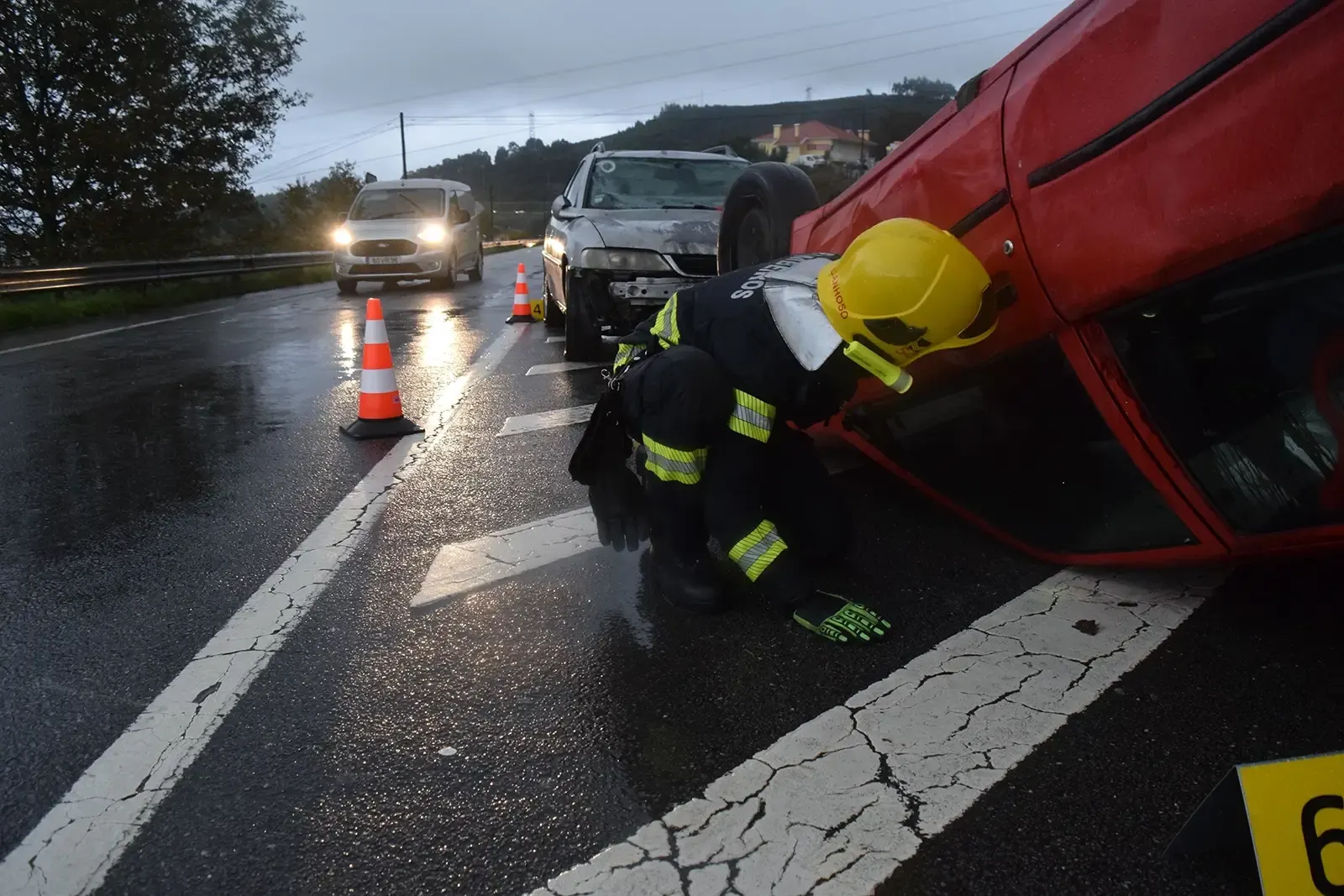
If you have found yourself in this situation, you should be aware that the law protects your right to full compensation. However, a lack of knowledge about time limits and how compensation is calculated means that many drivers, passengers and pedestrians accept compensation that is far lower than what they are entitled to.
This article explains what you should do following a road traffic accident, how compensation works in Portugal and how to respond to insurers’ actions, so that you can make informed and confident decisions.
What should you do immediately after the accident?
The moments immediately following the accident are crucial for securing evidence of the facts. The priority is always the safety and health of those involved, but, as soon as possible, you should take the following steps:
- Complete the Amicable Accident Report (DAAA): This must be signed by both drivers if there is agreement on the circumstances.
- Call the authorities (PSP or GNR): This is mandatory if anyone is injured (even slightly), if one of the drivers is missing documentation, or if there is no agreement on who is at fault. The police report will serve as vital evidence.
- Take photographs of everything: Images of the damage to the vehicles, their position on the road, skid marks and local road signs.
- Identify witnesses: Collect the names and contact details of anyone who witnessed the accident.
- Go to hospital: Even if you do not feel any immediate pain, the adrenaline rush can mask injuries. The A&E admission record is the first piece of evidence establishing a causal link between the accident and any bodily injury.
The insurance claim process: Legal deadlines you need to be aware of
In Portugal, the settlement of motor claims is subject to strict legal time limits set out in Decree-Law No. 291/2007. The claim must be reported to the insurer within 8 days.
From then on, the insurance company has specific time limits within which to respond (to accept or decline liability):
- Property damage only: 30 working days (or 15 working days if an Amicable Declaration has been signed).
- Personal injury (involving physical injuries): 45 days after the medical reports and clinical examination results have been made available.
If the insurer exceeds these time limits without a valid and substantiated justification, interest on late payment begins to accrue in favour of the injured party.
The problem of ‘Total Loss’: What to do if you do not want the money from the insurer?
One of the main sources of legal dispute arises when the insurer declares the vehicle a ‘Total Loss’. This happens when the estimated cost of repairs, added to the value of the salvage (what remains of the car), exceeds the market value of the vehicle prior to the accident (or 120 per cent of that value if the car is less than two years old).
The problem: The compensation amount offered by the insurer rarely allows the claimant to buy an equivalent car on the second-hand market.
The solution: The injured party is not obliged to accept the first offer. It is possible to challenge the market value attributed to the vehicle by referring to market listings for similar cars, or to demand that the vehicle be repaired if the cost of such repairs is not manifestly disproportionate to the damage caused.
Compensation for Physical and Non-Economic Damage: How is it calculated?
Unlike material damage (where it is sufficient to present the repair shop’s invoice), quantifying physical and psychological harm is complex. In Portugal, compensation is divided into three main categories:
1. Direct and Future Financial Losses
These include medical expenses, medication, transport costs for physiotherapy and lost wages during sick leave. It also includes what is known as ‘biological damage’, which compensates for the loss of future earning capacity if the injured party is left with a Permanent Partial Disability (IPP) that affects their professional activity.
2. Non-pecuniary Damages (Moral Damages)
These compensate for suffering and the loss of quality of life. They are usually divided into:
- Quantum doloris: The physical and psychological suffering resulting from the injuries and treatment (measured on a scale of 1 to 7).
- Cosmetic damage: The permanent alteration to the injured party’s appearance (scars, limping, etc.).
- Loss of personal fulfilment: The inability to continue practising sports, pursuing hobbies or enjoying a fulfilling sex life.
3. Compensation for Death
In the event of a fatal accident, the law provides for the right to compensation for the loss of the victim’s life, for the suffering endured by the victim before their death, and for the emotional distress suffered by close family members (spouses, children, parents).
Please note: Insurance companies often use purely indicative financial tables (the IRIS tables) which result in low figures. Portuguese courts apply criteria of equity that are far more realistic and fair to the injured party. Never sign a full settlement agreement with the insurer without checking that the amounts cover your actual loss.
Beware of the limitation period: Time is working against you
The right to claim civil compensation is subject to a limitation period of 3 years from the date of the accident, in accordance with Article 498 of the Civil Code.
However, if the accident constitutes a criminal offence (such as drink-driving, causing bodily harm through negligence or manslaughter), the limitation period may be extended to 5 or 10 years, depending on the specific criminal classification of the offence. Allowing these time limits to lapse means permanently forfeiting the right to compensation.
Frequently Asked Questions
I was a passenger in a car whose driver was at fault in the accident. Am I entitled to compensation?
Yes. Passengers in any vehicle involved in an accident are considered injured third parties under the law and are always entitled to full compensation for their damages, regardless of who the at-fault driver was.
Are pedestrians or cyclists always in the right in a collision?
Not always. The rule of contributory negligence applies. If the pedestrian was crossing a motorway on foot or if the cyclist ran a red light, the court will assess the percentage of fault attributable to each party. Compensation will be reduced in proportion to the injured party’s own share of the blame for the accident.
How long does it take to receive compensation for personal injury?
If there is an out-of-court settlement, it can take between 3 and 6 months after you have been given the all-clear by your doctor (when your injuries have fully healed). If legal proceedings are necessary because the insurer refuses to pay, the process can take between 1 and 3 years.
Speak to a solicitor before signing any settlement
Insurance companies have teams of experts and solicitors focused on settling claims at the lowest possible cost. To ensure you receive a fair amount that is proportionate to the impact the accident has had on your life, you need impartial, expert guidance.
Our team analyses the expert report and medical reports, and compares the insurers’ offers with the latest case law from the courts.
Book your consultation today and ensure that your rights are fully protected.
This article is for information purposes only and does not replace personalised legal advice. Legislation may change, so you should confirm the current position with a lawyer.